The Basics of Agentic Commerce Optimization
In September, OpenAI released Dots, Meta released Muse, and X released GrokBot, all autonomous AI agents. Now is the time to ensure your site is agent-friendly if you want to capitalize on the autonomous agent boom and what that could mean for your revenue.
In case you didn't know, here's what each of these products is:
-
Dots: OpenAI’s always-on agent that can work towards your goals over time using its own cloud computer.
-
Muse: Meta’s personal AI agent that can take on tasks, projects, and longer-term goals across the apps you use.
-
GrokBot: X’s always-on autonomous agent that works in tools and apps from its own computer to complete tasks for you.
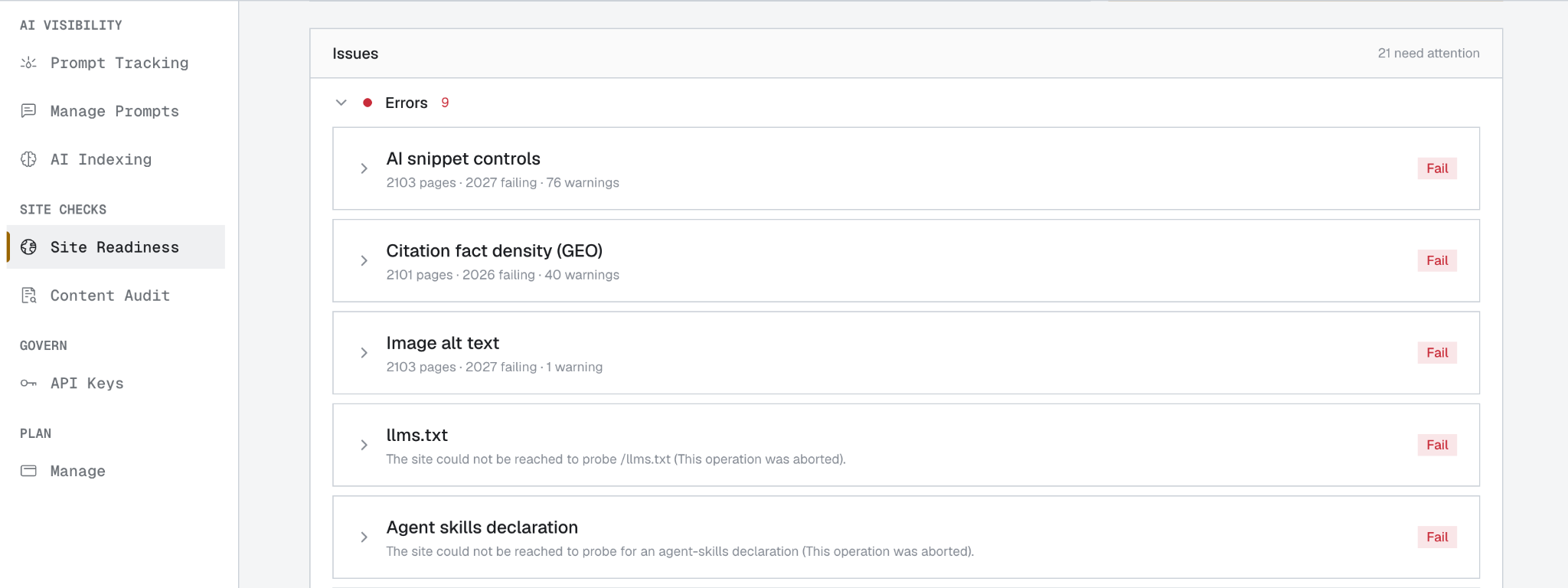
Here’s a checklist to help you decide whether your site is agent-ready. By the way, OpenLens runs these checks for you using your site’s data and provides engineering worklists. Also, you can see the journey an agent would take through your site to complete a purchase.
Your checklist:
Let’s go through what each standard is and whether your site needs it, including Google’s UCP (Universal Commerce Protocol) and the new agent payments protocol. We’ll also briefly go over Stripe’s agentic commerce protocol docs and Chrome dev guidelines on WebMCP.
Agentic Commerce Basics
The bare minimum of what you need to make your site agent-friendly. But first, a quick overview of how AI agents use the web.
First is a visual mode, where the agent takes a screenshot of a rendered page, then uses a vision model to guess where important buttons and fields are. Agents rely on visual cues, including size, contrast, and proximity (which is why following accessibility and CLS best practices has become increasingly important).
Second is DOM mode, where an agent reads the Document Object Model. It’ll read the raw HTML and accessibility tree. Accessibility trees are stripped-down APIs generated by browsers. When your browser loads a web page, it turns convoluted HTML and CSS into a simplified structural map. Agents rely on this map to understand element nesting and logical hierarchies.
Crawling vs. Browser Access
Crawlability and browser access are related but different. Agents that rely on web search or crawled indexes can only retrieve pages those systems have discovered, so allowing relevant crawlers in robots.txt helps them find and surface your content.
Browser agents can open and interact with a live page at task time: a page that OpenAI’s crawler cannot access may still be reachable to a browser-enabled OpenAI model. Optimizing for both can make your content crawlable for index-based discovery and usable in a browser for task completion.
A Clean Accessibility Tree
If you want your site to be accessible to agents, you have to clean up its accessibility tree:
-
Avoid ghost elements: Transparent overlays used for styling or tracking clicks.
-
Use strict semantic HTML: If something is a button, use a button tag. This also improves UX for people who rely on screen readers.
Don’t Rely Purely on JS for Client-Side Rendering
If your website relies entirely on complex JavaScript to load, an agent might fetch its HTML and see a blank page because the JavaScript hasn’t executed yet. Your core content has to be in your HTML.
Stable CLS
CLS stands for cumulative layout shift. It measures how much a webpage’s visible elements unexpectedly move while someone is using it.
Image Alt Text
Image alt text is an accessibility practice that’s been preached for years for image SEO. With the introduction of agentic commerce, image alt text is now an essential part of GEO.
Optimize for Agent Interpretability, Executability and Decision Reliability
A paper on agent-ready websites ran an experiment that compared two identical e-commerce prototypes.
One was built only for humans and optimized around the human experience; the other was built the same, with the same visual checkout flow, stock, and prices, except it was also optimized for agent interpretability, executability, and decision reliability.
When they ran agents across these two sites, the agent-ready sites achieved about an 89% success rate, while the human-centric baseline site achieved just 49%.
-
Reduce the number of steps required to complete purchases: We've seen this method used in traditional conversion optimization. Every extra step an agent has to take to complete a task reduces the chance it'll complete it, as it requires additional computing power.
-
Give agents structured evidence: The paper underlines that agents need evidence and temporal validity so they don’t hallucinate store policies. To provide decision reliability to bots, you must format your proof as verifiable metadata (tags, JSON-LD, etc.).
Emerging Standards
Declarative APIs (WebMCP)
Chrome outlined WebMCP to bridge the gap between DOMs designed for humans and the agents that use them. With WebMCP, developers can use declarative APIs to define elements instead of agents inferring them explicitly.
With a few extra lines of HTML, you can let agents know exactly which forms on your site are for customer service or booking an appointment. You can also tell agents what each field is for, like when a field requires a 10-digit phone number or an email address.
WebMCP also forces browsers to provide visual feedback when agents complete forms on human users' behalf with pseudo CSS.
llms.txt
Yes, we know that Search Central has said that llms.txt is bogus. However, it’s also a Lighthouse standard for agentic commerce. llms.txt is purely experimental. It is not a formal standard. Instead, it is meant to help AI agents save tokens by ensuring they mitigate parsing dense HTML documents.
UCP, ACP, AP2, and MCP
Alphabet soup for dinner, anyone?
MCP
Stands for Model Context Protocol, originally developed by Anthropic. MCP is becoming the universal standard for connecting AI agents to tools. You can build a read-only MCP server that serves your catalog without any auth or state to manage.
UCP
Stands for Universal Commerce Protocol, developed by Google and Shopify. This is how a business declares its capabilities. You host a manifest file at a specific URL, usually at /well-known/ucp. Agents can read this manifest to understand whether they can take actions like managing carts, tracking orders, or tracking an identity via an open authorization standard like OAuth.
ACP
Stands for Agentic Commerce Protocol, driven by OpenAI and Stripe. It outlines the highly specific, secure endpoints for creating and completing checkout requests, which can be wrapped as tools using MCP language.
UCP and ACP use MCP as their transport layers, meaning you only have to build your commerce server once.
AP2
The agents payment protocol, or AP2, was built by a coalition of some of the world’s biggest in finance, including Google and American Express. It helps ensure trust is explicitly stated upfront and cryptographically enforced through digital contracts called mandates.
There are two: the intent mandate and cart mandate.
-
Intent mandate: A secure, auditable ruleset that defines the boundaries of what an agent can do.
-
Cart mandate: A secure, unchangeable cryptographic record of what’s being bought, the merchant’s identity, and the final price.
The payment can only be authorized if the cart mandate matches the intent mandate.
Get Started with Agentic Commerce Optimization
OpenLens enables you to assess whether your site follows these standards. If not, it provides you with a fix you can generate, clarify, or get guided engineering help with. You can check whether your findings resolve with agentic readiness audits.
You can also run a real agent through your site to see whether it can complete a purchase or where it gets stuck.
Take control of agents' experience of your site with OpenLens. Sign up today to start tracking your first three brands for free.
Bibliography
Agent Payments Protocol contributors (n.d.) Agent Payments Protocol specification. Available at: online source (Accessed: Oct 2, 2026).
Elnaffar, S. and Rashidi, F. (2026) Designing Agent-Ready Websites for AI Web Agents: A Framework for Machine Readability, Actionability, and Decision Reliability. arXiv preprint, arXiv:2607.12056. Available at: online source (Accessed: Oct 2, 2026).
Google (n.d.a) Accessibility for agents. Available at: online source (Accessed: Oct 2, 2026).
Google (n.d.b) Cumulative Layout Shift (CLS). Available at: online source (Accessed: Oct 2, 2026).
Google (n.d.c) Declarative API. Available at: online source (Accessed: Oct 2, 2026).
Hardt, D. (2012) The OAuth 2.0 Authorization Framework. RFC 6749. Internet Engineering Task Force. Available at: online source (Accessed: Oct 2, 2026).
Howard, J. (2026) The /llms.txt file, v2. Available at: online source (Accessed: Oct 2, 2026).
Koster, M., Illyes, G., Zeller, H. and Sassman, L. (2022) Robots Exclusion Protocol. RFC 9309. Internet Engineering Task Force. Available at: online source (Accessed: Oct 2, 2026).
Model Context Protocol contributors (2026) Model Context Protocol specification. Version 2026-07-28. Available at: online source (Accessed: Oct 2, 2026).
OpenAI and Stripe (n.d.) Sellers: Agentic Commerce Protocol. Available at: online source (Accessed: Oct 2, 2026).
Universal Commerce Protocol contributors (2026) Universal Commerce Protocol overview. Available at: online source (Accessed: Oct 2, 2026).
WHATWG (n.d.) HTML Standard. Available at: online source (Accessed: Oct 2, 2026).
World Wide Web Consortium (2020) JSON-LD 1.1. Available at: online source (Accessed: Oct 2, 2026).
World Wide Web Consortium (n.d.) Images tutorial. Available at: online source (Accessed: Oct 2, 2026).