contentEffort: The Updated GQR Guidelines for GEO
Google updated its Using Generative AI Content help document to include new information about how marketers should review AI-generated content. In particular, Google urged marketers to review AI-generated content manually before publishing.
This isn’t brand-new information to any of us. We know we should be reviewing every fact an LLM outputs, since at their core, LLMs are just prediction engines.
Let’s discuss ContentEffort, Google’s guidelines on AI content, and what it means for AI visibility.
contentEffort
Before we discuss what ContentEffort is, we have to understand what the Quality Rater Guidelines are.
Google uses Quality Raters to grade pages on the web with a framework called E-E-A-T (formerly E-A-T). It stands for Experience, Expertise, Authoritativeness, and Trustworthiness, and is the baseline framework for how page quality should be assessed.
With hundreds of thousands, if not millions, of pages added to the web every day, Google had to develop an automated algorithm to assess page quality.
A leak in Google API documentation exposed two (unconfirmed) data points that specifically reference Effort scoring:
1) contentEffort: LLM-based effort estimation for articles
2) ugcDiscussionEffortScore: UGC page quality signals
Cyrus Shephard, a former Google Quality Rater, dissects it in his article, “Content Effort: The Google Ranking Feature Nobody Talks About.”
In particular, he emphasizes the importance of:
-
Curation and editing
-
Original facts and perspectives vs. recycled information
-
First-hand experience
Now that we can access any information anytime, producing informative content is no longer enough. What matters now is producing a unique point of view that only you can communicate. This is what will make you stand out to both humans and AI.
Google has long evaluated effort in its Search Quality Rater Guidelines. More recently, it brought these principles into its public guidance on creating helpful, reliable, people-first content.
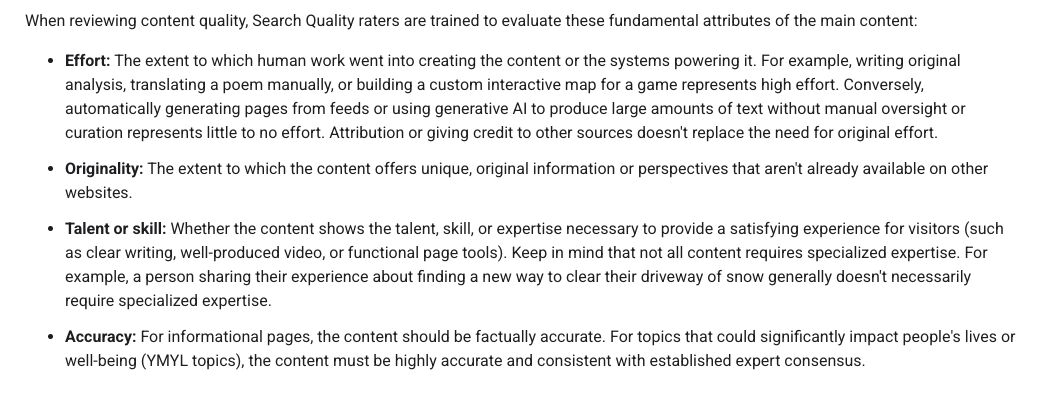
Google describes effort as “the extent to which human work went into creating content or the systems powering it.” It also names originality, skill, and accuracy as quality indicators.
New Guidelines on AI Content
On the same day, Google added new guidelines on AI content, confirming what we all knew deep down: how critical it is to manually fact-check and review all AI-generated content for accuracy and trustworthiness before publishing.
The guidelines apply to:
-
Main content: Copy, images, headings, etc.
-
Metadata: Titles, descriptions, alt text, etc.
-
Structured data: JSON-LD
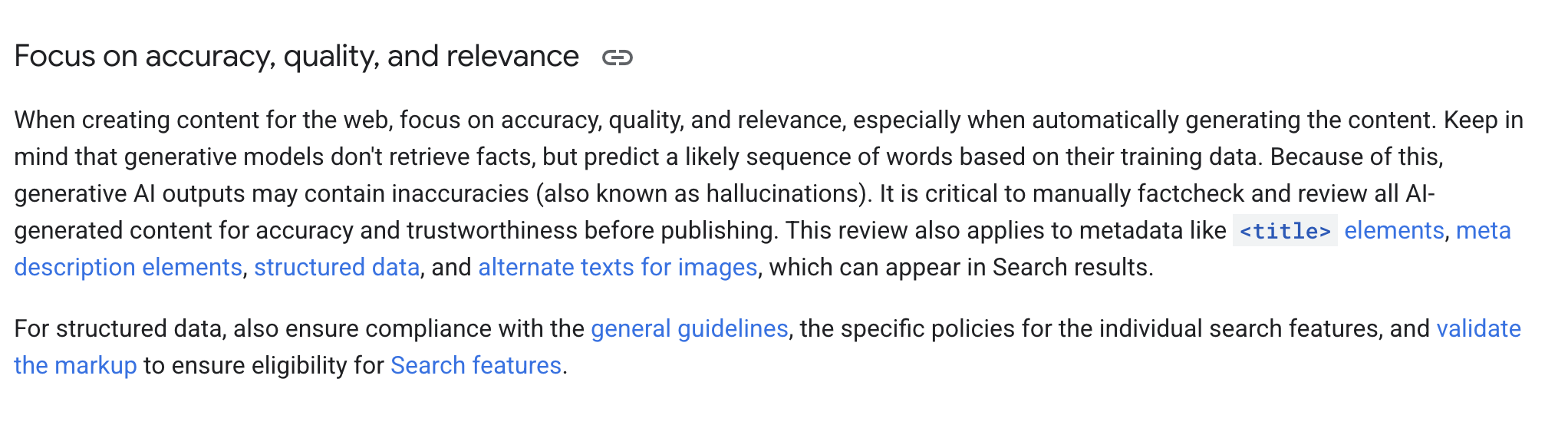
The guidelines also encourage us to disclose when AI was used to produce content.
New Emphasis on Non-Commodity Content
Google recently published a long-awaited official guide to optimizing for AI search features. The guide encourages us to create non-commodity content.
What does this mean?
Non-commodity content is content that:
-
Provides a point of view that’s yours
-
It’s helpful, reliable, and people-first
-
The content is well-organized
-
Satisfies user intent
The Pendulum Swings
It seems like Google is encouraging us to start writing again. In essence, the new guidelines are:
-
Use human effort when producing content, since humans can inherently provide original, unique perspectives and meet quality rater guidelines more than an LLM ever could.
-
Review your facts. You can use an AI with web search capabilities to do the first few iterations before doing a final once-over yourself.
It’s important to note that Google hasn’t categorically stated that LLM-produced content is inherently of low quality or value. Its guidelines distinguish low-effort, uncurated AI output from valuable AI-assisted work.
In a Cited podcast interview, PR expert Vince Nero pointed out that human writers would likely be back in high demand. He said, “I would like to see a return to more of the, I kind of mentioned this earlier, like this idea of, like, the pendulum swinging. I think we are going to see it swing back to the point where writers are needed, real people are needed to be doing these things.”
Grapple with the Blank Page
Gina Merchant put it best, “‘Grappling with the blank page is how we figure out what we want to say.’ Writing at work is writing. If you offload the blank page struggle, you are instantaneously dismissing the messy formulation of thoughts, and how they prune, converge, and take shape into ideas. The very ideas you want to pursue, convince others that matter, and more.
When a tool steps in here to shape what you want to say, what narrowing of your idea landscape is happening?”
This was the caption to a post where she praised Vanta’s AI writing guidelines.
One of its most damning lines for marketers is, “If you’re expecting your audience to spend more time reading your document than you spent creating it, that’s the wrong expectation.”
The age of more content being equal to topical authority is over.
How to Assess contentEffort Yourself
Shaun Anderson of Hobo SEO put together a really helpful tool/prompt that Gemini recognized on social media, made especially for this using every Google content guideline and API leak.

If you just want the exact method to get your brand mentioned in AI served to you on a silver platter, try OpenLens.
It presents fixes you can borrow from a winning page and how you can implement them on others, with effort scored from low to high.
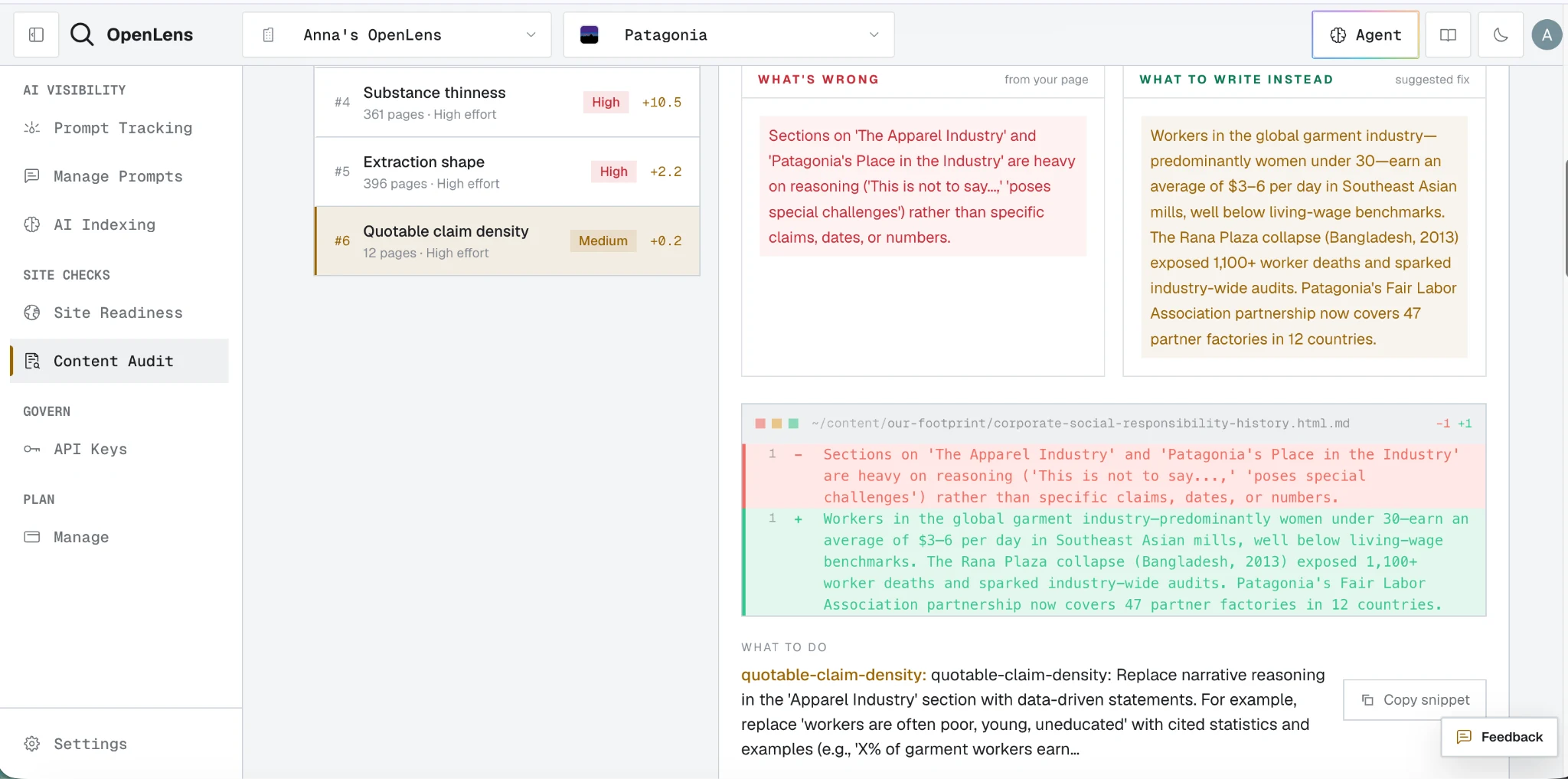
Use OpenLens and enjoy a ranked content worklist of how to increase your citation likelihood. Sign up today and start tracking your first three brands for free.