How to Write E-Commerce Product Pages That Actually Get Cited
To write a page that’s ultra-citable, do the following:
-
Be ultra-specific: Describe what makes your products worth people's money, who it’s for, and what it solves.
-
Structure content in a way that’s machine-friendly. Use statistics, bullet points, tables, and organize your content into sections.
-
Write for humans first, always. Lead with value and solutions, not specs.
More information on how to do that, including examples and guidance from GEO and e-commerce copywriting experts, is right this way.
Be Ultra Specific
In an interview with OpenLens, Myriam Jessier said, “You need to be so good, so clear, that a machine looks at this and goes, I better not hallucinate. The answer is right there. Let me make the effort and go get it.”
If your product description is so boring and generic that ChatGPT could’ve written it, you’re probably not going to get cited.
Let’s say you’re selling coffee. Your product description likely describes its origins, how to prepare the coffee, and a bit of brand story. Pretty standard.
Here’s a product description from an e-commerce site for Jacob’s coffee:
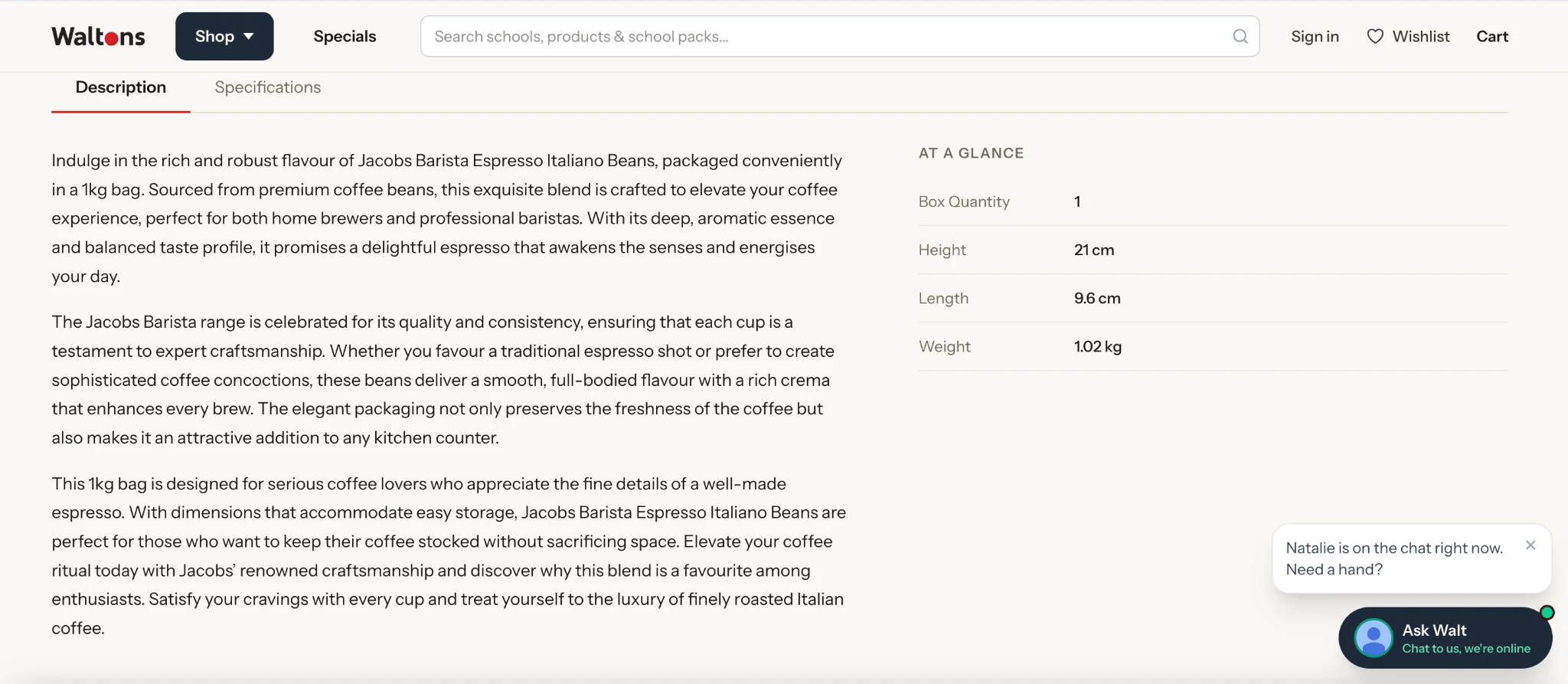
It says, “Indulge in the rich and robust flavor of Jacobs Barista Espresso Italiano Beans, packaged conveniently in a 1kg bag. Sourced from premium coffee beans, this exquisite blend is crafted to elevate your coffee experience, perfect for home brewers and professional baristas. With its deep, aromatic essence and balanced taste profile, it promises a delightful espresso that awakens the senses and energises your day.
The Jacobs Barista range is celebrated for its quality and consistency, ensuring that each cup is a testament to expert craftsmanship. Whether you favour a traditional espresso shot or prefer to create sophisticated coffee concoctions, these beans deliver a smooth, full-bodied flavour with a rich crema that enhances every brew. The elegant packaging not only preserves the freshness of the coffee but also makes it an attractive addition to any kitchen counter.
This 1kg bag is designed for serious coffee lovers who appreciate the fine details of a well-made espresso. With dimensions that accommodate easy storage, Jacobs Barista Espresso Italiano Beans are perfect for those who want to keep their coffee stocked without sacrificing space. Elevate your coffee ritual today with Jacobs’ renowned craftsmanship and discover why this blend is a favourite among enthusiasts. Satisfy your cravings with every cup and treat yourself to the luxury of finely roasted Italian coffee.”
It’s a block of text that doesn’t tell us anything about the flavor profile of the coffee. It’s marketing fluff.
How could a machine tie concepts like “exquisite blend” to concrete facts?
Compare it to this one:
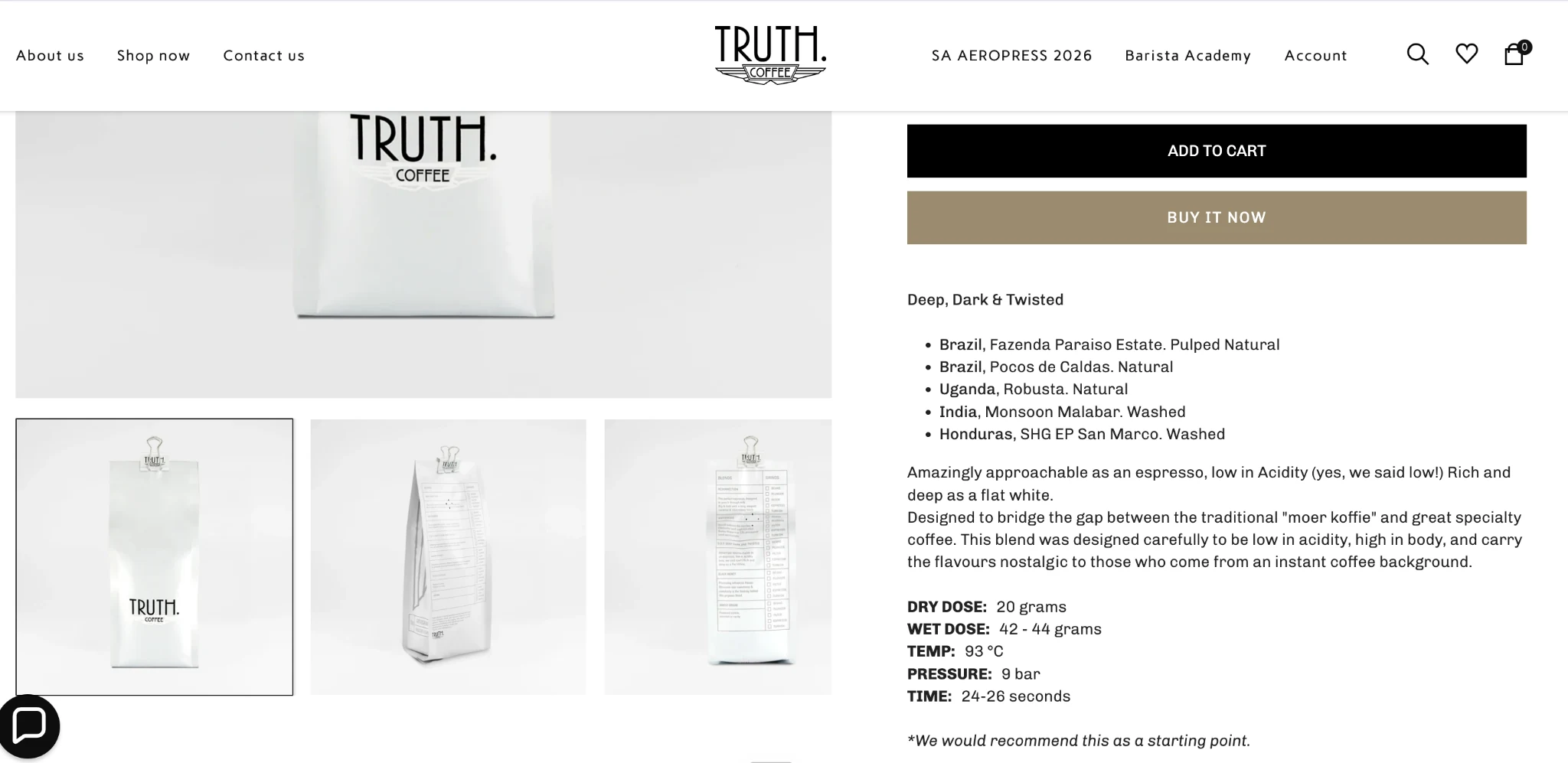
This product description reads,
“Deep, Dark, and Twisted:
Brazil, Fazenda Paraiso Estate. Pulped Natural
Brazil, Pocos de Caldas. Natural
Uganda, Robusta. Natural
India, Monsoon Malabar. Washed
Honduras, SHG EP San Marco. Washed
Amazingly approachable as an espresso, low in Acidity (yes, we said low!) Rich and deep as a flat white.
Designed to bridge the gap between the traditional "moer koffie" and great specialty coffee. This blend was designed carefully to be low in acidity, high in body, and carry the flavours nostalgic to those who come from an instant coffee background.
Dry Dose: 20 grams
Wet Dose: 42 - 44 grams
Temp: 93 °C
Pressure: 9 bar
Time: 24-26 seconds
*We would recommend this as a starting point.”
You can tell exactly which one was written by a coffee freak vs. Gemini, right? Being able to know this difference and apply it to your content is what will get you cited and make your content irresistible to LLMs.
Notice how this product description:
-
Tells us exactly how many degrees Celsius our water should be
-
Exactly where the beans were sourced from
-
How to prepare it in detail
-
Who the coffee is for
How to Achieve Ultra-Specificity in Copy
To maximize the substance of the information you’re providing, Myriam says your copy needs to name entities.
We hear about these a lot in GEO discourse, but what are they?
Entities are universally recognized things. They’re any uniquely identifiable, well-defined "thing, like such as a person, place, organization, product, service, or abstract concept, that AI systems and large language models (LLMs) recognize.
To achieve ultra-specificity in your sentences, you should:
-
State the relationship between your brand and the entity you’re selling.
-
Have a verb that ties the entity to the condition
-
Preserve that condition and make it specific
Let’s make this practical with an example.
-
Let’s name an entity → the Asana Enterprise Plan.
-
Let’s name an action it does → It streamlines task management
-
With what condition → For teams over 100 people.
-
And the specifics? → Starting at $24.99 per user.
So: the Asana Enterprise Plan streamlines task management for teams over 100 people starting at 24.99 per user.
With our coffee example, that means we should specify:
-
The name of the coffee
-
How one should best prepare it
-
Its conditions
-
Why it’s great
-
Its specifics
When an LLM has to infer meaning, it’s computationally expensive. Why waste compute putting the dots together on what “synergy” could mean or what a product might do?
Your End-to-End Content Process for Ultra-Specific, Citable Product Pages
List Your Keywords and Prompts You’re Targeting
First, examine your product and list possible applicable keywords. You can speed this up with a DataForSEO MCP connection and specific instructions to only include BOFU (non-informational or navigational, only ready-to-buy) keywords.
Separate these into high-volume, broad keywords and long-tail, lower-volume keywords. These long-tail keywords may also be viable prompts to target.
Examine Pages That Are Cited for the Prompts You’re Targeting
Once you know which long-tail keywords or prompts you'd like to target. Use your AI visibility tool to see which pages are cited in the LLMs you're tracking for the prompts you would like to be cited for. Note:
-
Page structure
-
Copy structure
-
Types of images used
-
On-page social proof
-
Off-page social proof
Do this for the first three to five product pages. Do this by hand and map what you see onto a Google Sheet.
Decide on Your On-Page Elements
A citable product page has four core on-page elements:
-
A headline answer.
-
A long description with product specifications
-
FAQs (sourced from People Also Asked on Google)
-
A “who this is for” section
-
Product images that are machine-readable
-
On-page reviews
Your output should include the elements of the most-cited product pages that you mapped out.
Headline Answer
Your headline answer, or short description, should:
-
Describe the entity (product) and your brand's relationship to it
-
Have a verb that ties it to the condition of the problem it solves
-
Describe the specificity of the condition
Long Description
Your long description should not be a wall of text that says nothing (read: second coffee description above).
Instead, it should be scannable, easy to read, and include a specifications table and bullet points.
-
Scannability: Use a combination of H2s and H3s. These are also a good place to include keywords for SEO purposes.
-
Easy to read: Write at a sixth- or seventh-grade level, avoiding unnecessary jargon and addressing the reader directly (use the second person).
-
Specifications table: Specifications tables provide structured on-page data about your product or service that are easy to cite. You can include entities like measurements, people, dates, times, and more.
-
Bullet points: A good rule of thumb is to format lists of four or more in bullet points.
FAQs
We use FAQs in content because LLMs answer in Q&A format most of the time. If an LLM is looking for an easy answer to a commonly asked question that you have the street cred to answer, it’ll likely cite your page.
The easiest way to do this is by looking at People Also Asked and Reddit. Add four to five questions searched for to your content. If possible, include a mix of niche questions that don’t have many answers and most-asked questions.
-
People Also Asked: Type in the keywords you most want to target and scroll to the People Also Asked Section.
-
Reddit: Type in your keyword and look for recently asked questions about what you’re selling.
Answer these with unique information that your brand or the product it’s selling can use to satisfy the query well.
‘Who This Is For' Section
As LLMs can take increasing amounts of personal context into account when searching, it’s more important than ever to add that ultra specificity we discussed above into your copy.
Obviously, you don’t have to type Who This Is For as your H2. In fact, the most elegant solution here is to use a keyword + USP plug. In the case of coffee, we might say something like, “Quick Grind Dark Roast Coffee Beans for On-the-Go Use.
If ChatGPT knows that its user is a working professional who is slightly snobby about coffee but still has a relatively busy day, this heading is like a billboard with strobe lights on it that say “Pick me!”.
Machine-Readable Images
This might come as a no-brainer, but your images must depict what you are describing with words.
According to multimodal GEO expert Myriam Jessier, images have two different meanings:
-
Connotation: What’s associated with them, or what you’re saying with the image.
-
Denotation: What the image means.
You can use Google Cloud Vision API or Azure Vision API to test your images for their meaning. You can use their demos for free without having to hook up the API.
In e-commerce, it’s imperative that your images match what you describe in your copy. If you’re selling bouquets of roses, tulips, and sunflowers but your product images show no sunflowers, the machines parsing your product page will have less confidence in its meaning because of the mismatch.
Your product images should have what you’re trying to convey in them. So, if your product makes it easier for people to have fun in the workplace, there should be people wearing workplace attire in an office setting doing office activities. There might be a laptop on a table and a printer in the background.
On-Page Reviews
On-page reviews make any page more citable, since LLMs cite products by trying to gather human consensus that they’re worth others’ money and time, just like we do.
Structure Content in a Way That’s Machine-Friendly
You can structure content to be machine-friendly by:
-
Using structured data (JSON-LD/schema markup)
-
Using an optimal extraction shape
-
Ensuring high quotable claim density
-
Adding recency signals
Here’s what each of these means and how to implement them.
Structured Data
Structured data, also known as JSON-LD, is a code snippet inserted below your page’s head tag. It provides structured, standardized, machine-readable data and is parsed by LLMs as part of a page’s source code. LLMs have no way to verify structured data.
You can ensure your product page structured data updates automatically by connecting your storefront’s API to your schema generator relatively easily, particularly if you’re a WooCommerce or Shopify user.
Optimal Extraction Shape
Extraction shape is how content is formulated to be readily extractable by LLMs. Use bullet points, comparison tables, FAQ blocks, named tiers, and bolded factor lists. This is easier for both humans and machines to parse.
High Quotable Claim Density
Quotable claims are specific numbers, named entities (like people, institutions, etc.), and concrete numbers (like prices, statistics).
When your page has enough substance, you’ll naturally have enough quotable claims for a citable page. Use bullet points, comparison tables, FAQ blocks, named tiers, and bolded factor lists. This is the machine-readable structure that LLMs prefer to retrieve and present content with.
Write for Humans First
Though it may seem like we’re heading toward a future where websites become an information source for LLMs and nothing more, we’re not there yet. This means you should write for humans first and optimize for LLMs.
Use good grammar, humor (where appropriate), organize information well, and lead with nuanced experience, which trumps generic expertise. Create content that satisfies queries and is helpful before being citable. If you do this, citations will follow naturally.
Create Citation-Worthy Content with OpenLens
OpenLens is an all-in-one AI visibility tool that helps brands ensure their websites are AI search-ready and their content is citation-worthy.
OpenLens gives you targeted fixes to ensure your content has optimal extraction shape, high quotable claim density, structured data, and other tactics to increase your likelihood of citation or mention.
Once you’ve implemented the recommended fixes, OpenLens helps you measure where you stand on mainstream AI platforms like ChatGPT, Claude, Grok, Perplexity, DeepSeek, Gemini, and Google AI Overviews.
Sign up for OpenLens to track your first three brands for free. Enjoy the content audit, site readiness, and agent readiness today.